










This Book @ Amazon.com (From $38.97)
This Book @ Amazon.ca (From $CAN 40.71)
This Book @ Amazon.co.uk(From £28.50)
= Amazon.com |
= Amazon.co.uk |
= Amazon.ca.
|
|
|
|
|
|
|
|
|
|
|
|
|
|
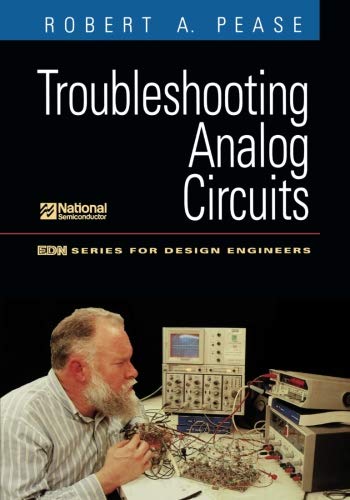
| Review Troubleshooting Analog Circuits
Review written by: Lawrence W. Dobbins From Phila. PA
I have been a fan of Bob Pease's articles for a long time. This book is excellent for analog circuit design, for example, I learned about preventing reverse polarity in power supplies from this book. Pease is an excellent writer. He presents excellent methods for testing the stability of circuits by driving the output with square waves!
Larry Dobbins
Very good, awesome fun too
Review written by: Luca Fascione From Wellington, New Zealand
Ok, it's clear Bob Pease is waaay good. And we're fine with that. The book is VERY good, very clear in all the aspects, and in all I am very happy to have it. If you read this, you will find many other books use Bob's advice and circuits. I am learning how to build tube amps, and this book almost only talks in terms of low voltage circuits, but still it's incredibly useful.
Highly recommended if you are to build reliable circuits
You'll learn something from this book
Review written by: davez From LA, CA, United States
Bob has written a book that only Bob can write. It may seem somewhat anecdotical. But Bob is a legend, he can get away with it. You may or may not like his style, but if you read it, you'll learn something from it.
Oldie but Goodie
Review written by: Richard C. Ortlip From Phila, PA
This was written some time ago, but all information is still real and true. Bob has a way with making learning fun. He should have been a teacher; in fact he is in this book. How about more bob!
Of some value, but not about troubleshooting
Review written by: Adam Luoranen From Santa Cruz, CA
Troubleshooting Analog Circuits takes a device-centric approach. About half of the chapters focus quite specifically on a type of device, and proceed to tell you a few common ways in which that type of device can fail. The other half of the chapters are quite random and don't seem to fit together very well, although they also contain useful information.
The primary theme in this book could be condensed quite simply: Don't assume anything. A recurring theme in the book is "This type of component is usually pretty reliable, but might sometimes be out of tolerance, so don't assume it's correct." Pease reiterates this same theme for resistors, capacitors, test equipment, circuit configurations, and so on. Virtually everything boils down to "x might not work, so if the system it's in doesn't work, x could be the problem".
This, in turn, means the book boils down to little more than a collection of random observations which normally would remain unpublished in some engineer's notebook, but are just valuable enough to make a published book in this case, because Pease has so many decades of experience that his experience is worth a bit more than the standard spurious observation. Even so, this book is in no way a comprehensive guide on how to troubleshoot anything. It really is a collection of thoughts and tips from Pease; it should be called "Bob Pease's Book Of Tips And Tricks".
Pease is also singularly obsessed in his hatred of SPICE. While he's correct that SPICE can't be relied upon for perfectly accurate simulation of anything, it's funny that he rejects its use so strongly in a book whose overwhelming theme is that *EVERYTHING* is unreliable. The accompanying photo of Pease throwing a computer off a roof is, like the rest of the book, amusing but hardly useful. In the end, this book contains a lot of information that *could* be useful, but don't rely on it as any kind of resource on troubleshooting. It has little to do with troubleshooting at all; its main audience is seasoned engineers who can benefit from a fellow engineer's experiences.